
A Recent Study in China
A recently published study in China looked at whether a person’s homocysteineHomocysteine is an amino acid found in the blood. Elevated levels of homocysteine have been associated with narrowing and hardening of the arteries, an increased… level predicted their risk and degree of cognitive decline. They did this by taking Alzheimer’s disease patients classified as mild, moderate or severe on a cognitive test (MMSE) and compared them to healthy people of the same age.
As severity of Alzheimer’s went up, so did homocysteine. Those classified as mild had an average level of 16.8mcmol/l, those classified as moderate had a level of 21 and those classified as severe had a level of 26.
There was a very strong correlation with the MMSE cognitive score and homocysteine level as shown by this graph below.
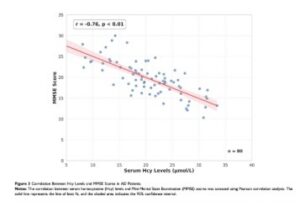
The authors conclude “These results demonstrate that serum Homocysteine level is a promising biomarker for assessing Alzheimer’s disease severity, offering significant potential for predictive assessment and monitoring in clinical practice.
The Six Month B Vitamin Regimen
The researchers gave all Alzheimer’s disease patients a standardized B vitamin intervention regimen for six months.
At the end of six months there had been a significant decrease in homocysteine levels in all three severity groups and their cognitive function, as measured on the MMSE scale, had improved. Also, their level of homocysteine at the start of the study correlated with their degree of improvement.
The authors conclude “This finding further supports the potential utility of serum Homocysteine as a dynamic monitoring indicator for tracking disease progression and treatment response in Alzheimer’s.” So, homocysteine is both a predictive biomarker and a dynamic biomarker in that lowering it results in cognitive and clinical improvement.
How to Get Tested & B Vitamin Regimen
I sincerely hope that the growing and consistent evidence for homocysteine as a biomarker, and lowering it with B vitamins as a treatment, will be adopted by health care providers around the world.
Meanwhile, it is up to individuals to both test their cognitive function at foodforthebrain.org and also homocysteine level through a home-test kit, then take an appropriately dosed B vitamin supplement, such as Connect.

Comments
Join the Conversation on our Facebook Page